Game rules and model: two experiences
Both modes ask you to read the score, downs, field position and remaining time. They share a football strategy interface, but their endings and feedback are different. Choose the mode that fits the decision you want to practice.
| Question | Real-game endings | Original drills |
|---|---|---|
| Where do I start? | Recent completed games and 20 archived 2023 snapshots, with the score, clock, ball, downs and timeouts from the source. | 6 fictional training situations. |
| When does it end? | At the end of regulation, including opponent possessions and untimed extra-point choices when needed. | After one offensive possession: scoring, a turnover or time running out can end the drill. |
| Who calls the defense? | The opponent chooses its own plays. You manage your timeouts on defense and advance its snaps. | A simplified simulated defensive look helps explain the training choices. |
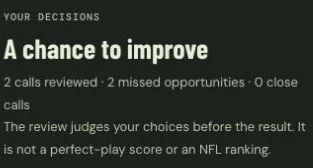
| What is the feedback? | New endings use descriptive decision reviews. Older saves can retain their original numerical score. | A separate rule-based teaching grade and practice target. |
| How far can I kick? | Field goals are available within this game’s 65-yard limit. Displayed make rates are game estimates, not a specific kicker’s real probability. | |
A touchdown adds six points; a field goal adds three. After a touchdown, real endings can offer a one-point kick or two-point try. A tied regulation finish is not displayed as a win, and overtime is not simulated. For button-by-button help, use how to play.
How do new games arrive?
We check nflverse data every 15 minutes. A completed game becomes playable only after its final score and full play-by-play agree and it has a suitable fourth-quarter situation. Not every game qualifies. The data provider usually updates cleaned play-by-play after game days, so an ending may arrive later than the final whistle.
Recent endings prioritize the current season and the last 14 days. When no recent ending qualifies, the latest available starts remain dated clearly. The season follows regular-season and playoff schedules, including playoffs in January and February.
Everyone gets the same daily starting situation for a UTC date. Once selected, that daily stays fixed. New games can enter practice during the day. Corrections create a new starting snapshot; saved matches and challenge links keep their original facts. The 2023 collection remains in Historical practice.
During an update delay, the last verified collection stays playable. See nflverse’s update schedule for source timing and statistical corrections.
What is historical, and what is simulated?
Recorded starting facts
Recent completed-game snapshots, the 2023 archive and filtered ending logs come from public nflverse play-by-play. A source game ID and play ID identify the starting record. The historical final result remains separate and is revealed after a match or inside a spoiler section.
Sampled continuations
Your next result is drawn by this game’s model. Historical versions use calibrated outcome distributions for broad call categories, including yards, clock effects and turnovers. Your exact sequence of future plays is not a recording from the source match.
Counterfactual comparisons
The review compares available choices by simulating continuations from the same pre-call situation. Those continuations include an opponent policy. Changing that policy or uncertain late-shot rates can change a close comparison.
A short sideline target is not a charted receiver route, and a deep target is not a player-specific matchup. Public play-by-play can record target direction and air yards—the distance the throw travels—without proving the intended play design or defensive call. The field’s routes and defenders are illustrations.
The game rules and model do not make a late completion certain. A pass can fail, a kick can miss, and the opponent can answer. Identical starting conditions, rules, seed and actions reproduce the game sequence; choosing different actions can use the random sequence differently.
Read the choice before judging the result
- Better option available
- The model found a meaningful conservative gap in favor of another call across the assumptions it checks. Read the situation and suggested alternative before retrying it.
- Close call
- The choices are too close or sensitive to assumptions to call this a clear mistake. A narrow estimate should not be read as certainty.
- Reasonable choice
- No clearly stronger alternative was found in that comparison. It can still produce a bad result; the label is not a guarantee of a win.
- Low-odds finish
- The modeled options had little chance of rescuing the ending. A difficult position alone is not proof that your last decision was poor.
“No clear mistakes found” is an ending summary, not a claim of perfect play. “Review pending” means the comparison is not ready. Analysis runs in a browser worker; if it cannot run, the game still lets you play and clearly says that analysis is unavailable.
How to interpret model evidence
The model scores finishing ahead as 1, tied as 0.5 and behind as 0. The tie weight is a comparison convention, not an estimate of overtime victory. The numbers are sampled continuation results under the game’s policies, not validated real NFL win probabilities.
The current review uses a pilot comparison followed by independent confirmation samples and conservative uncertainty checks. The displayed sensitivity range stresses selected assumptions, not every possible source of error. The actual outcome of your played call does not retroactively change that pre-call judgment.
Game rules and model limits worth knowing
- No overtime, penalties, injuries, onside kicks or detailed return game.
- No individual player abilities, real receiver-route editing or verified defensive intent.
- Kickoffs and punts are simplified. Historical rules-era parameters and transition distributions do not recreate every real event.
- Finite samples, sparse late-clock observations, omitted factors and opponent-policy assumptions limit counterfactual comparisons.
Data calibration and independent checks help diagnose the model; they do not establish that a particular alternate real-world ending is correct. This is an independent game, not an NFL product or a coach-ranking system.
Which game rules and model apply to an older result?
Look for “Older saved match” above the field before comparing feedback. A current descriptive review and an older numerical score are different forms of feedback; a larger old score does not establish that the newer reviewed decisions were worse.
Older saved matches retain their supported engine version, outcomes and feedback. New rules do not silently recalculate those saves. Public challenge links also name a scene pack, engine and seed; unsupported versions produce an unavailable-link message instead of opening a different challenge.
My progress derives totals from retained local records and keeps original teaching grades separate from real-ending reviews. It does not invent overwritten historical practices or a lifetime total. Saving, sharing and clearing details explain the separate groups.
Data and further reading
2023 nflverse source CSV ↗ · Play-by-play release ↗ · nflreadr field dictionary ↗ · CC BY 4.0. Starting facts and filtered logs are adapted from nflverse; the continuation and review are the game’s model.